Human trafficking and modern-day slavery can be defined as an act that “involves transporting, recruiting or harboring people for the purpose of exploitation, using violence, threats or coercion.” (Anti-Slavery International, 2020)
Our community partner was Ken Gilmore, from Guardian Group, which is an organization that works to find and help victims of human trafficking, and tries to bring down the people in charge of it. His job specifically, is to find information that could possibly lead them to find and capture the trafficker, as well as rescuing the victim.

While talking to him about human trafficking and slavery, he informed us about the “code system” that could be used to purchase humans and adds to a large amount of trafficking that goes on throughout social media. Traffickers use a sort of code system throughout social media and other sites that inform buyers about available purchases and other offers. The traffickers create a business through this and can make quite a bit of money off of selling humans into slavery.

Retrieved from http://www.vawlearningnetwork.ca/our-work/
issuebased_newsletters/issue-2/index.html
Created : 02/18/20 10:56AM
An important thing to consider while talking about human slavery, is the values and beliefs shown throughout, and how they play a large part in slavery and trafficking. According to Milton Rokeach (1968), values can be defined as strong convictions about what is right or wrong. Values are stronger and more personal than attitudes, but oftentimes less numerous. Values are deeply held and are closely tied to personal identity. He also refers to beliefs by saying, personal beliefs are opinions that all individuals hold about their environment and their place in that environment.
Values and beliefs are shown in human slavery and trafficking through how one sees themselves and their environment around them, and how these certain things could make them an easy target for trafficking. Ken Gilmore explained to us how traffickers look for girls with low self-esteem, and beliefs about themselves. He said that parties might be set up by traffickers looking specifically for girls like this, and will target and manipulate them, quickly becoming in control of them.

Retrieved from https://www.mprnews.org/story/2014/09/10/
report-maps-minneapolis-sex-trafficking-market
Created : 02/18/20 10:43AM
It might be easy for one to wonder why it is so hard for victims of such trafficking to get out of it and leave it, but our community partner explained that it is hard for them because they have nowhere to go and are also scared of what the trafficker might do. To put in a different way, and maybe an easier way to understand, it is similar to the situation of an abused spouse. They are scared and have no support or anyone to talk to, making it extremely hard to get out of that kind of situation.
It is important to note how in this situation of control and power over another human, how the different values and beliefs are shown. Referring back to the definition of the beliefs; opinions that all individuals hold about their environment and their place in that environment, it shows how the person in control sees themselves in a position of power in the environment surrounding them. This is also showing their personal identity, and how this is closely tied with values.
Human slavery is quite a prevalent issue throughout the entire world, with large amounts of sex trafficking and other types of human slavery happening not only in the Middle East within countries like Iran, but also in North America through gangs. Our community partner, Ken Gilmore mentioned that the Mafia and the Chinese Triads are leaders in Human Slavery, as well as American gangs, through sex trafficking, labor, and more.
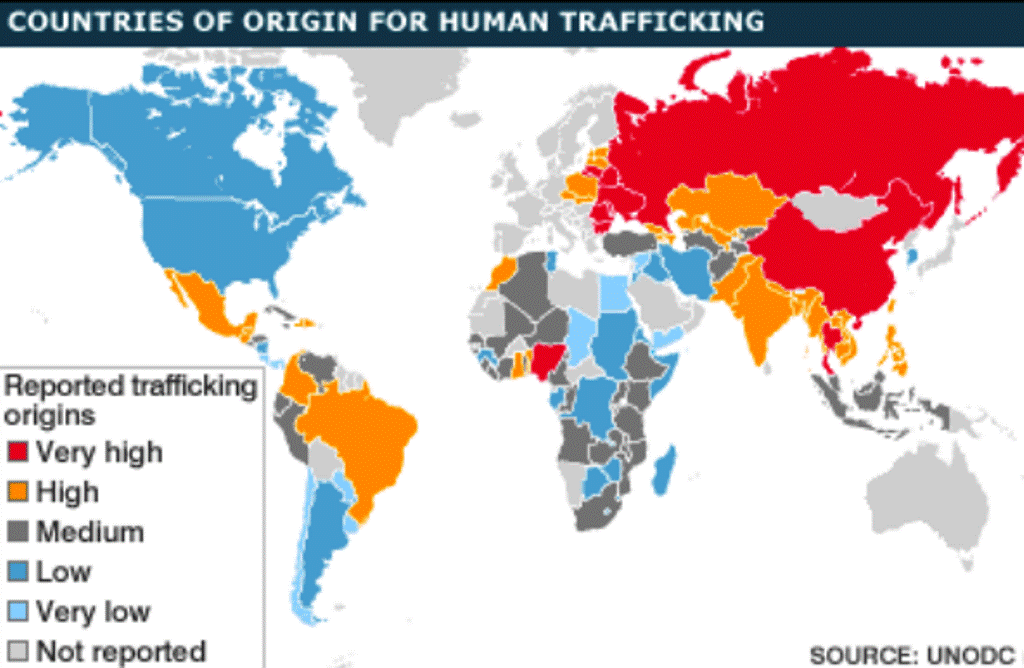
gallery/
Created : 02/18/20 10:47AM
It is not uncommon for gangs to have illegal immigrants under their control, just by threatening to turn them in and get them deported. They often use this power over them to have them do labor like transporting drugs and using women for sex trafficking.
Our Community Partner Ken Gilmore talked a lot about human trafficking in the Middle East, specifically Iraq and Seria where he focuses a lot of his time and effort towards helping the victims. Something that he mentioned that really stood out was how much of a cultural difference there was and how that affected their values and beliefs, and how they saw human slavery.
The Koran, which is an Islamic sacred book allows people of different religions than Islamic to be taken from their homes. Gilmore said that a specific case he had been working on for awhile refers to this.
A girl and her family were given a three-day notice that she would be taken. The family could not do anything about it, and could not flee without risking all of their lives. They just had to stay put and wait for their daughter to be taken from them and become a victim of human trafficking because she was not of the Islamic religion.
This shows how different religions can play a large part in people’s values and beliefs. Part of what affects your values and how you perceive things due to your beliefs is religion culture, and what you grew up with. In Islamic countries, they were taught that according to the Koran, that human slavery is okay, especially if the victims are of a different religion.
Depending on one’s beliefs, dangerous working conditions and working for little to no wage are considered acts of human slavery. This was an important topic that was brought up by Ronald Takaki in his book, A Different Mirror. He said “The ‘factory girls’ also worked in dangerous conditions. On January 10, 1860, a terrible tragedy occurred at Lowell’s Pemberton Mill. A building suddenly collapsed trapping nine hundred workers, mostly Irish women; then a fire broke out, adding to the terror and destruction. One hundred and sixteen were seriously hurt while eighty-eight were killed.” (Takaki, p.150)
Looking at this with the values/beliefs lens, it is easy to see how the terrible working conditions and low wages are acts of human slavery. The person in control has more to gain by using the workers than they could lose by employing them. It is important to note the definition of belief here, where it mentions how one feels about their surrounding environment. This is quite applicable here given the number of things the factory owner must have overlooked by putting their workers in such a situation, and how their values were much different than some
Another thing that might make someone think about values and beliefs in regards to human slavery is presentism. Presentism is how one perceives past events while looking at it with modern-day values. This is particularly relevant in Postman’s Amusing Ourselves to Death. He shows presentism when he says “Can you imagine, for example, a modern economist articulating truths about our standard of living by reciting a poem?” (Postman, p. 23) This is his explanation of presentism which helps us understand how it is used to view history, particularly slavery in this case.
For example if we saw slavery as inhumane and not okay, it might be different in 1810 for example, when their values and beliefs were different, according to their environment around them. This is a big factor in how one might perceive human slavery through the lens of values and beliefs.

https://www.guardiangroup.org/
Created : 02/18/20 11:11AM
Overall human slavery is quite relevant today and is still an issue that we are working towards ending. Though it may not be as talked about or known now, it is still as relevant as it was in the 1800’s. There are many organizations working to stop this, like Ken Gilmore’s group, Guardian Group, and much more.
References
Gilmore, K. (2020, February 10). [Personal interview by the author].
Postman, N. (1985). Amusing Ourselves To Death (20th Anniversary ed.). Penguin Books.
Rokeach, Milton. (1968). Beliefs, attitudes, and values. San Francisco, CA: Jossey-Bass.
Takaki, R. (2008). A Different Mirror (Revised ed.). Back Bay Books.
What is Modern Slavery? (n.d.). Retrieved February 18, 2020, from Anti-Slavery website: https://www.antislavery.org/slavery-today/modern-slavery/
 Human Slavery